
Gaztron’s Water Electrolysis Technology
Our high-pressure bipolar water electrolysis technology offers a simple and rapid means of producing hydrogen, utilizing only power and deionized water. Our product line includes systems capable of producing hydrogen at rates ranging from 0.25 Nm3/hr up to 500 Nm3/hr for a single electrolyzer. For higher production capacities, multiple electrolyzers can be connected to common subsystems.
Gaztron’s Water Electrolysis Technology
Gaztron’s water electrolysis hydrogen plant offers several features and benefits, which include:
- Bipolar systems are skid mounted, while PEM generators are constructed with panels from Proton NEL.
- Installation is easy, with the system typically handed over within a week.
- PLC control enables fully automatic operation.
- The system can be designed for load following or tank filling mode.
- Efficient power usage keeps the cost of production low.
- High standards of instrumentation and adherence to Hydrogen safety codes.
- Add-ons such as a booster compressor allow for high pressures up to 700 bar(g).
- Built to withstand Indian climatic conditions, Gaztron’s Hydrogen Gas Generator is a reliable choice.
How it Works?

Bipolar Technology – Using Alkaline electrolyte
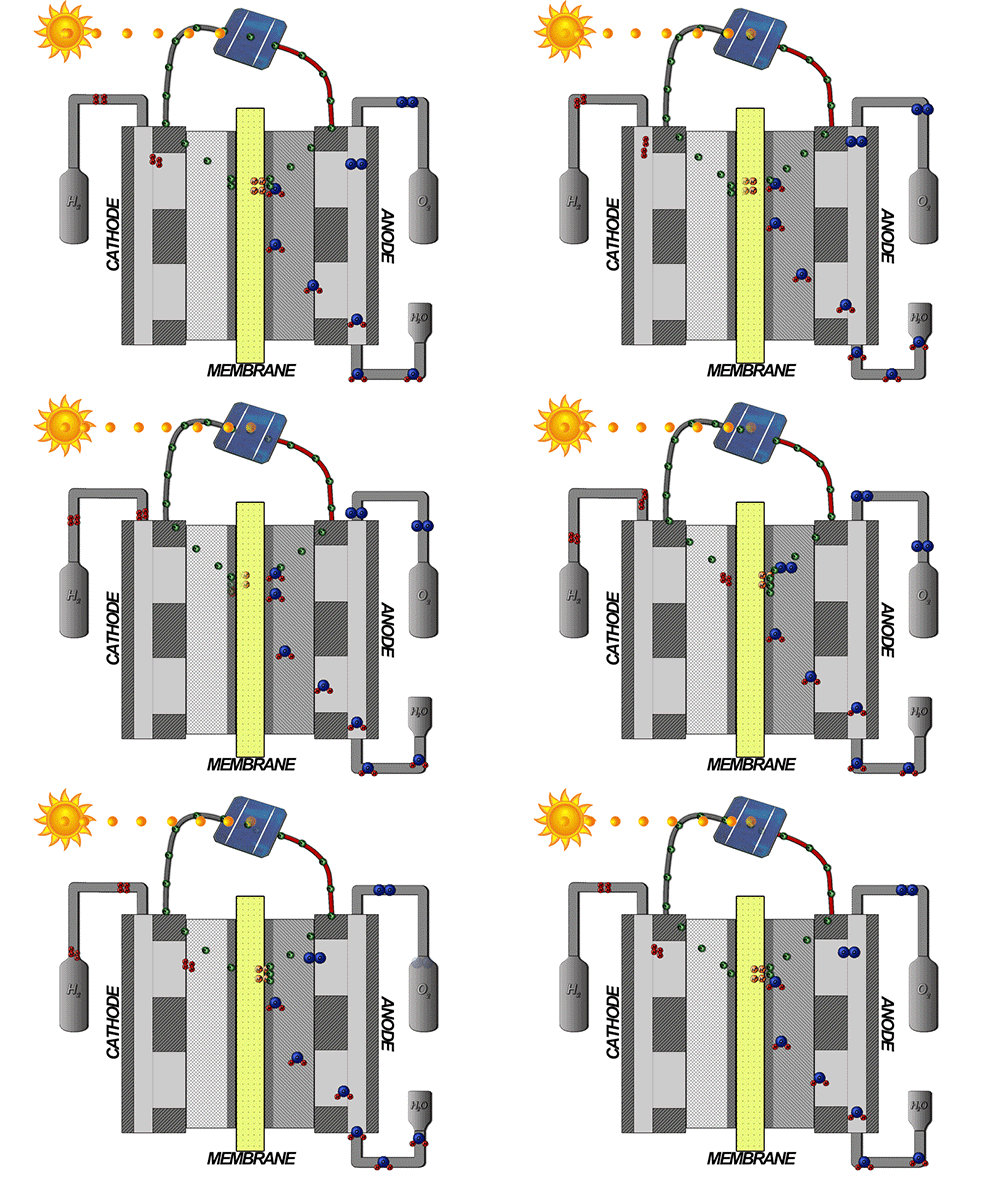
Proton Exchange Membrane (PEM)
Technical Specifications
| Technical Specification | GAZ-NPH | GAZ-NPS | GAZ-NPMC | GAZ-NPC |
|---|---|---|---|---|
| Hydrogen production | 2 to 6 Nm³/hr | 0.25 to 1 Nm³/hr | 10 to 30 Nm³/hr | 250 or 500 Nm³/hr |
| Hydrogen purity | 99.9995% H₂ | 99.9995% H₂ | 99.9998% H₂ | 99.95% – 99.9995% H₂ |
| Hydrogen dew point | 99.999% by vol | 99.999% by vol | -72°C | H₂O < 5 ppm |
| Hydrogen delivery pressure | 15 Bar or 30 Bar | 15 Bar | 30 Bar | 30 Bar |
| Oxygen | Automatic, PLC Controlled | Automatic, PLC Controlled | Automatic, PLC Controlled | Automatic, PLC Controlled |
| Electrolyte | Export steam | Export steam | Export steam | Export steam |
| Power requirement | 6.8 – 7.3 kW/Nm³-H₂ | 6.7 kW/Nm³-H₂ | 5.8 – 6.2 kW/Nm³-H₂ | 1.25 MW or 2.5 MW |
| Utilities required from customer | Power, Deionized & Cooling Water | Power, Deionized & Cooling Water | Power, Deionized & Cooling Water | Power, Deionized & Cooling Water |
Gaztron’s Hydrocarbon – Reforming Technology
Gaztron’s Steam Reformer – Natural Gas / LPG / Naphtha
Our advanced production process for high purity hydrogen involves the steam reforming of hydrocarbons, followed by a PSA purification step. The feedstock is preheated by mixing it with a split stream of hydrogen and passing it through a sulfur removal process. It is then combined with superheated steam and passed through catalyst-filled reformer tubes, where it is converted into a syngas containing H2, CO, CO2, H2O, and CH4.
The hot syngas is then cooled through a heat exchanger, which recovers a significant amount of its sensible heat, before being passed through the CO-shift stage. The syngas is further cooled to ambient temperatures, resulting in the condensation and subsequent separation of water vapor. Finally, the purified hydrogen is isolated to the desired level of purity using a molecular sieve PSA purification unit.
The reformer is fired by a high-velocity burner that consumes both fuel and tail gas. Any tail gas produced during the PSA purification stage is buffered in the tail gas buffer tank. The hot flue gases generated by the reformer are directed towards a waste heat boiler, which is used to superheat the feed/steam mixture and preheat the feed in the heat exchangers.
Gaztron’s Steam Reformer – Methanol Reforming
Technical Specifications of Our Hydrocarbon
| Technical Specification | Steam Methane Reformer | Methanol Reforming |
|---|---|---|
| Feedstock | Natural Gas (Methane), LPG, Naphtha | Methanol (e.g. British Standard BS 506) |
| Capacity Range | 200 – 6,500 Nm³/hr (single reformer) | 200 – 5,000+ Nm³/hr |
| Hydrogen purity | 99.999% by vol | 99.999% by vol |
| Hydrogen delivery pressure | 15 Bar | 15 Bar |
| Operation | Automatic, PLC Controlled | Automatic, PLC Controlled |
| By-product | Export steam | Export steam |
Major Applications
Our steadfast commitment to research and development has established us as pioneers in the field of pure hydrogen technologies, with widespread applications in various industries globally. By continuously emphasizing innovation, we have secured our position as industry leaders in meeting the diverse demands for hydrogen in various industrial sectors.